


IR-Coaster's Space Odyssey: A Year in Orbit for an Astrochemistry Laboratory
After more than a year of exposure to the extreme conditions of space, the IR-Coaster instrument was successfully recovered on February 27, 2026, and returned to its home laboratory. This device is poised to deliver groundbreaking findings on the evolution of organic matter in an extraterrestrial environment. IR-Coaster was designed and fully developed at LISA with technical and financial support from the French National Centre for Space Studies (CNES).
A Successful Orbital Mission
On February 27, 2026, SpaceX’s Dragon CRS-33 cargo spacecraft splashed down in the Pacific Ocean off the coast of San Diego (California), carrying the IR-Coaster (InfraRed-Cubic Orbital Astrobiology Exposure Research) experiment—a miniaturized astrochemistry laboratory. The instrument had been launched to the International Space Station on November 5, 2024, before being installed on the Bartolomeo external platform of the European Columbus module. It was exposed to the vacuum of space and unfiltered solar ultraviolet radiation for nearly a year, from December 16, 2024, to December 28, 2025.
IR-Coaster represents a major technological breakthrough. Until now, organic samples exposed outside the International Space Station could only be analyzed before departure and after their return to Earth. For the first time, an onboard infrared spectrometer enabled direct in-orbit analysis, providing regular and in situ monitoring of the chemical evolution of the samples.
This unprecedented capability allowed the study of molecules essential to astrochemistry and exobiology:
● glycine, an amino acid that is a building block of proteins
● uracil and guanine, nucleobases found in RNA and DNA
● mellitic acid, an indicator of chemical evolution on Mars.
“With IR-Coaster, we achieved a world first: directly monitoring, in space, the evolution of molecules essential to life using infrared spectroscopy. Analyzing the data brought back to Earth will now allow us to take a step forward in understanding the fate of these building blocks of life in the space environment and their possible role in the emergence of life,” states Hervé Cottin, scientific lead for the IR-Coaster project and university professor of chemistry and astronomy at UPEC and LISA.
An Instrument Entirely Designed in a Research Laboratory: LISA
The IR-Coaster instrument marks a major milestone for LISA. It was fully designed, developed, and assembled within the laboratory by the technical department, under the direction of Noël Grand, CNRS research engineer and project manager, with support from the CNES technical teams. Scientific coordination was led by Hervé Cottin (UPEC) and Fabien Stalport (Université Paris Cité), both of whom conduct their research at LISA. Preparatory studies, as well as the processing of IR-Coaster data at LISA, have been and continue to be supported by CNES.
Weighing approximately 10 kg and with compact dimensions (15 × 30 × 40 cm), IR-Coaster demonstrated its robustness and ability to meet the ISS’s strict safety requirements while withstanding the extreme conditions of the space environment.
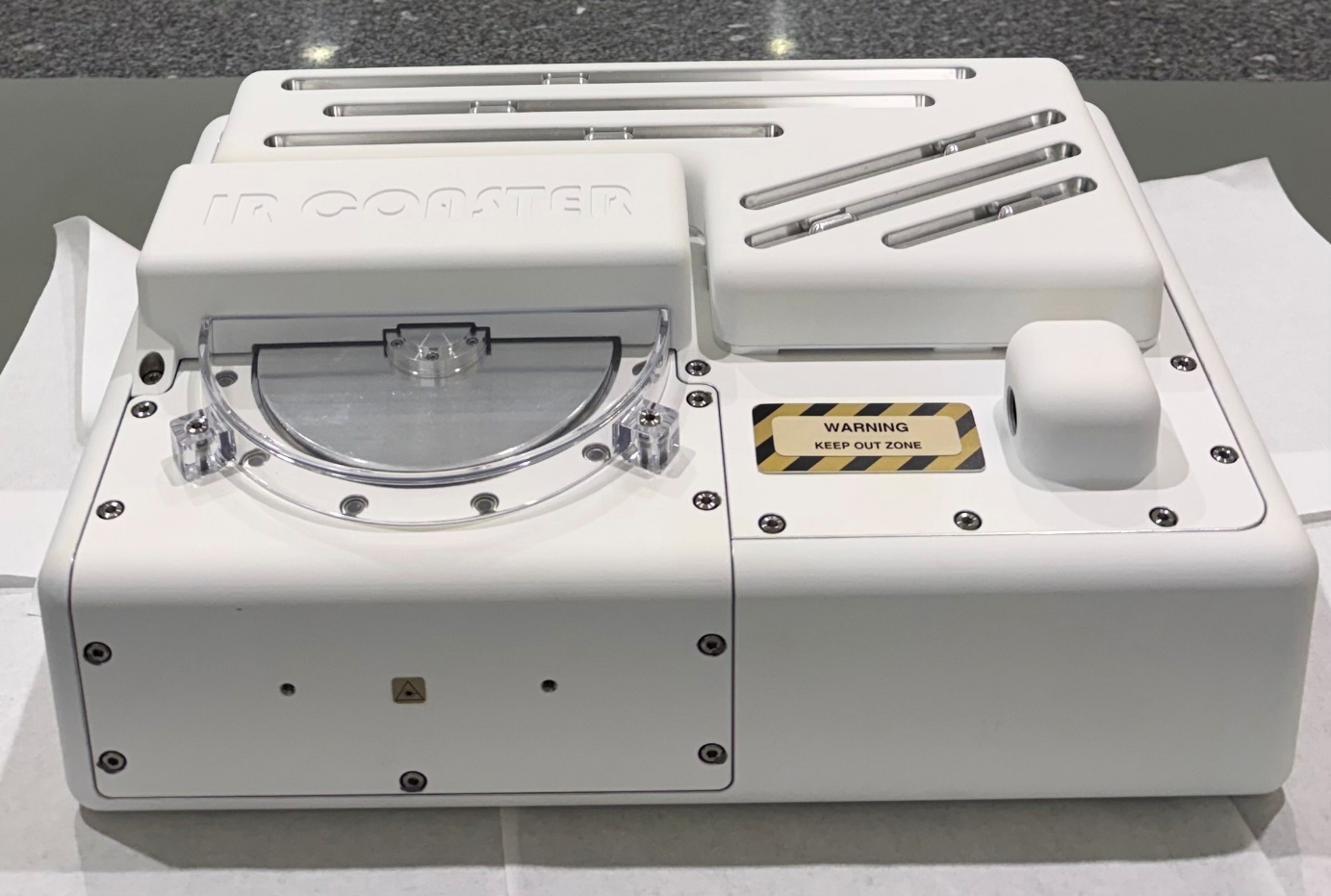
Boitier d’IR-Coaster avec son carrousel fermé (crédits : LISA/CNES)
Next Steps: Data Exploitation
Upon its arrival on French soil, the instrument passed through CNES for a visual inspection and initial functional tests. It then returned to LISA just two weeks after splashdown.
The LISA technical team can now extract flight data from the memory cards, including the recorded infrared spectra tracking the samples. An in-depth phase of data analysis and processing is now underway, involving scientific teams to interpret the signals collected in orbit. This includes Juliette Pastore, a third-year PhD student at LISA, whose thesis focuses on this subject. Combining these data with new laboratory analyses will enable scientists to model—with unprecedented precision—the stability of the building blocks of life in space.
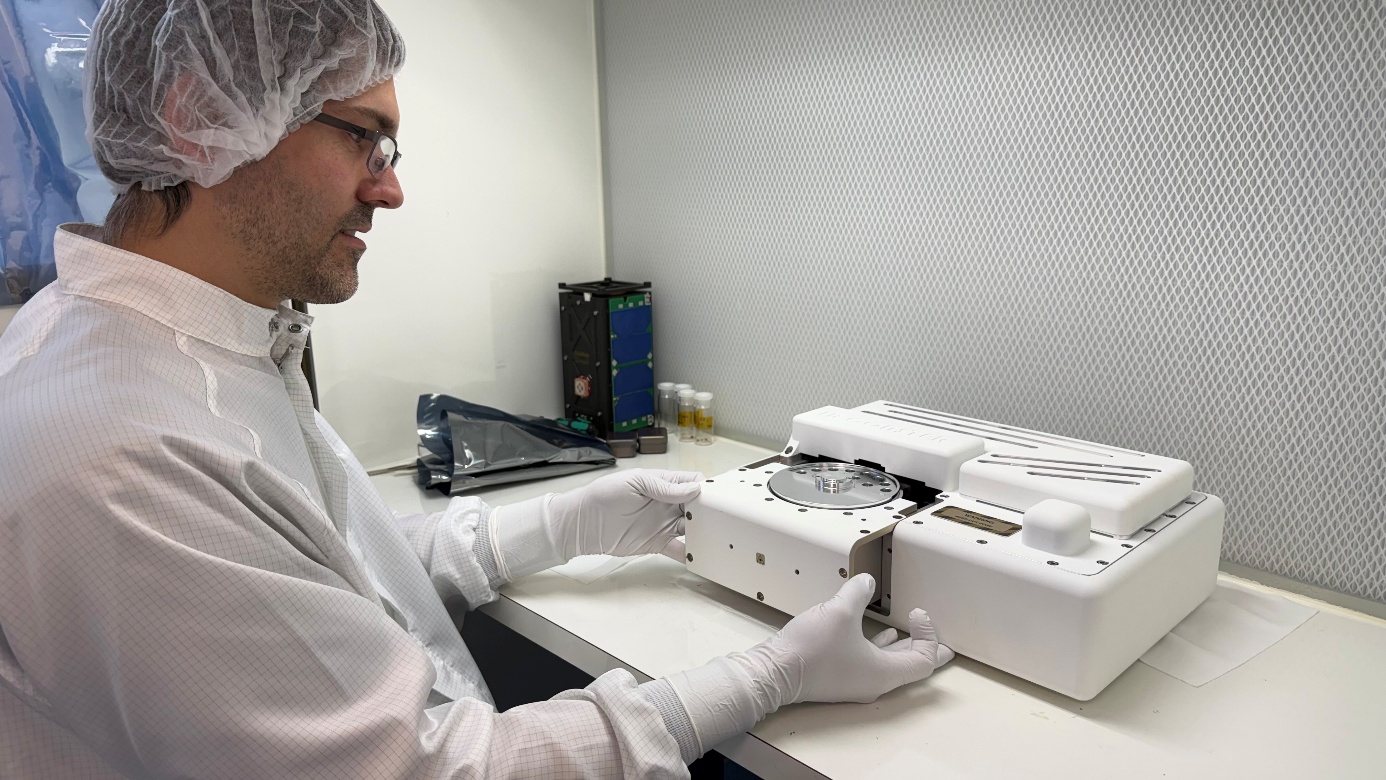
Pascal, ingénieur au LISA ouvre le boitier d’IR-Coaster (crédits : LISA/CNES)
A Foray into Artistic Creation: The Oscar Project
IR-Coaster also carried the Oscar art project, designed by visual artist Stéphane Thidet and produced by the CNES Space Observatory as part of its contemporary creation support program.
This musical work is based on the temperature fluctuations recorded in flight during exposure to the Sun. Their transformation into sound material, as well as the spatialization of the piece, were developed by LISA according to the artist’s vision, showcasing a fruitful collaboration between scientific research and artistic creation.
IR-Coaster Project Participants:
Hervé Cottin, Fabien Stalport, Noël Grand, Juliette Pastore, Rachel Gonthier, Nathalie Carrasco, Léo Balzano, Anaïs Feron, Maxime Feingesicht, Cécile Gaimoz, Sarah Gomes, Mathieu Gourichon, Kristian Harge, Florian Huet, Xavier Landsheere, Inès Louison, Noel Mombazet, Florent Mignon, Sylvain Triquet, Lisa Viallon, Pascal Zapf, Isabelle Savin De Larclause, Didier Chaput, Christian Mustin, Michel Viso
More informations :
Illustration Video
IR-Coaster launch