


Ice cores from Mont Blanc reveal a close link between Saharan dust deposits in Europe and the climate over the past 8,000 years
Atmospheric aerosols play a key role in the regional climate, yet they remain poorly understood. Ice serves as an archive of past climate, aerosol load, and composition. Located nearly 1,500 km from the world’s largest desert, Alpine ice should therefore allow us to examine the link between Saharan dust deposition over Western Europe and past climate—a link that has yet to be established.
We examined the chemical composition of terrestrial aerosols present in an ice core extracted from the summit of the Dôme du Goûter in the Mont Blanc massif, which has recorded the evolution of aerosols in Europe over the past ~12,000 years (Legrand et al., 2025). These measurements—which include water-insoluble dust, calcium, strontium, aluminum, and the alkalinity of the ice—demonstrate the major role of Saharan contributions to the deposition of terrigenous aerosols in Western Europe. The continuity of Saharan contributions over time is particularly evident from the significant presence of calcium in the form of calcite and an excellent correlation between calcium and strontium across all time periods.
In the ice of Mont Blanc, the beginning of the Holocene (between 4,000 and 8,000 years ago) is characterized by low Saharan contributions, followed by a sharp increase linked to the aridification of the Sahara, marking the disappearance of the “Green Sahara ” approximately 3,600 years ago—a phenomenon linked to the southward shift of the monsoon in response to the decline in solar radiation during the latter half of the Holocene. Climate signals from ice deposited over the last two millennia—better documented in terms of aridity in Africa and temperatures in Europe—clearly reveal key climatic periods: the Roman Warm Period (between 1,700 and 2,100 years ago), the Late Antique Cold Period, followed by the Medieval Climate Anomaly (between 750 and 1,200 years ago), the Little Ice Age, and the contemporary period. Here we observe an increase in Saharan dust deposits during warm periods, associated with increased aridity in the Sahara linked to a positive NAO driven by increased solar radiation and/or a decrease in volcanic activity. This link between Saharan dust transport to Europe and climate could, in the future, constitute a significant positive feedback loop by accelerating the retreat of Alpine glaciers following a decrease in albedo (due to colored snow).
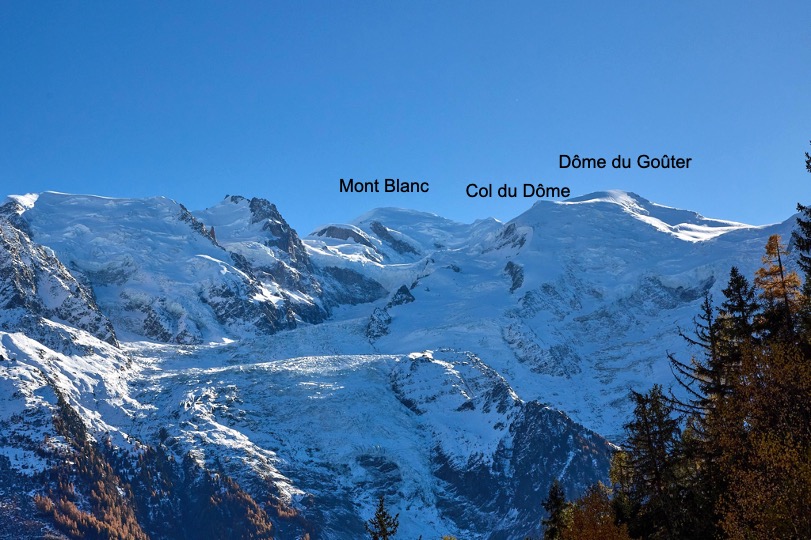
The summit of the Dôme du Goûter (4,305 m) to the right of Mont Blanc, as seen from the Chamonix Valley.
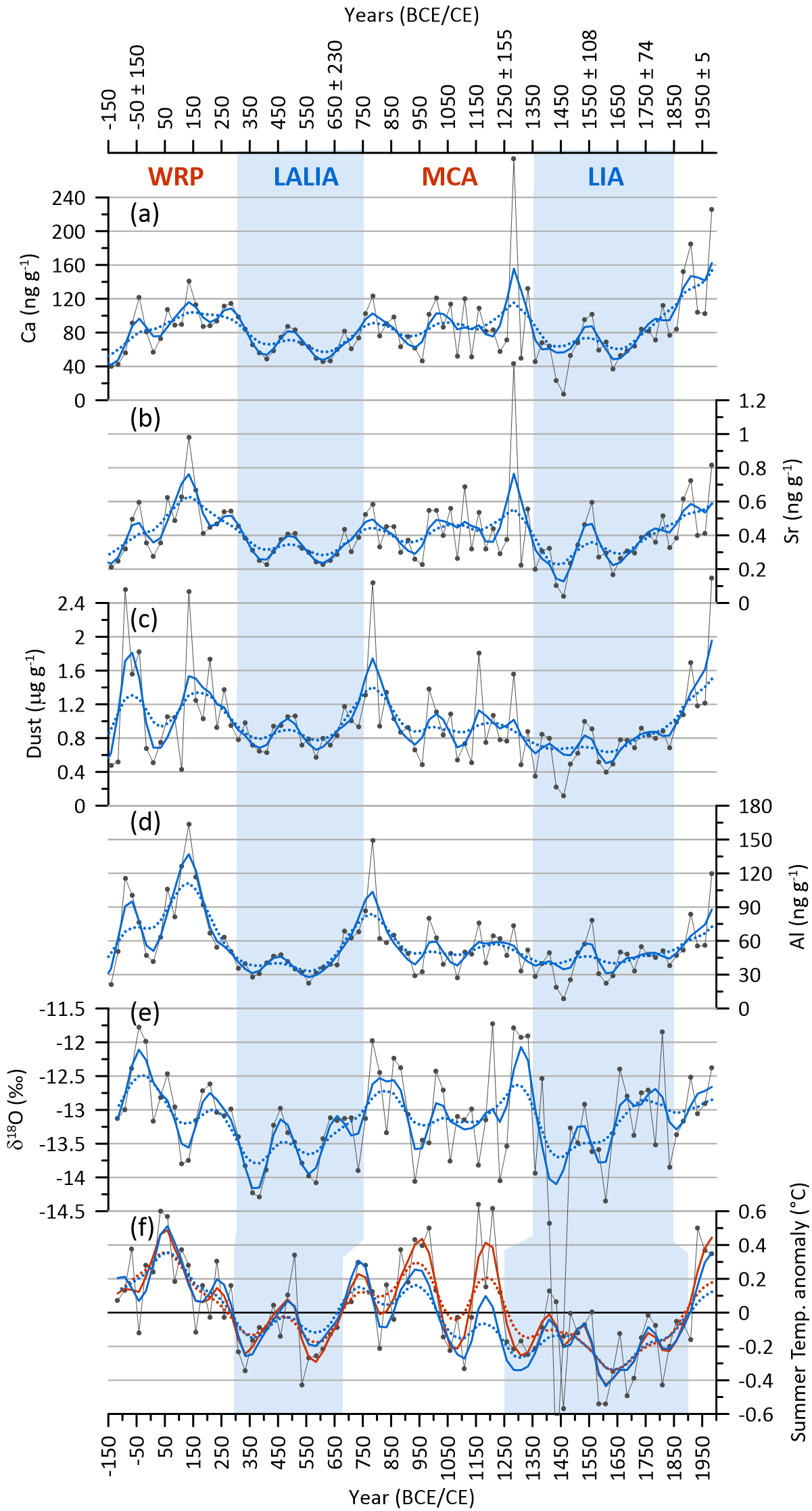
Figure 1. Changes in calcium (a), strontium (b), insoluble dust (c), aluminum (d), and d18O (e) in the ice at the Dôme du Goûter deposited over the last two millennia, and summer temperatures in Europe reconstructed from independent records such as tree rings (f). The vertical blue bands indicate the two cold periods of this era, namely the Little Ice Age (LIA) and the Late Antique Cold Period (LALIA).
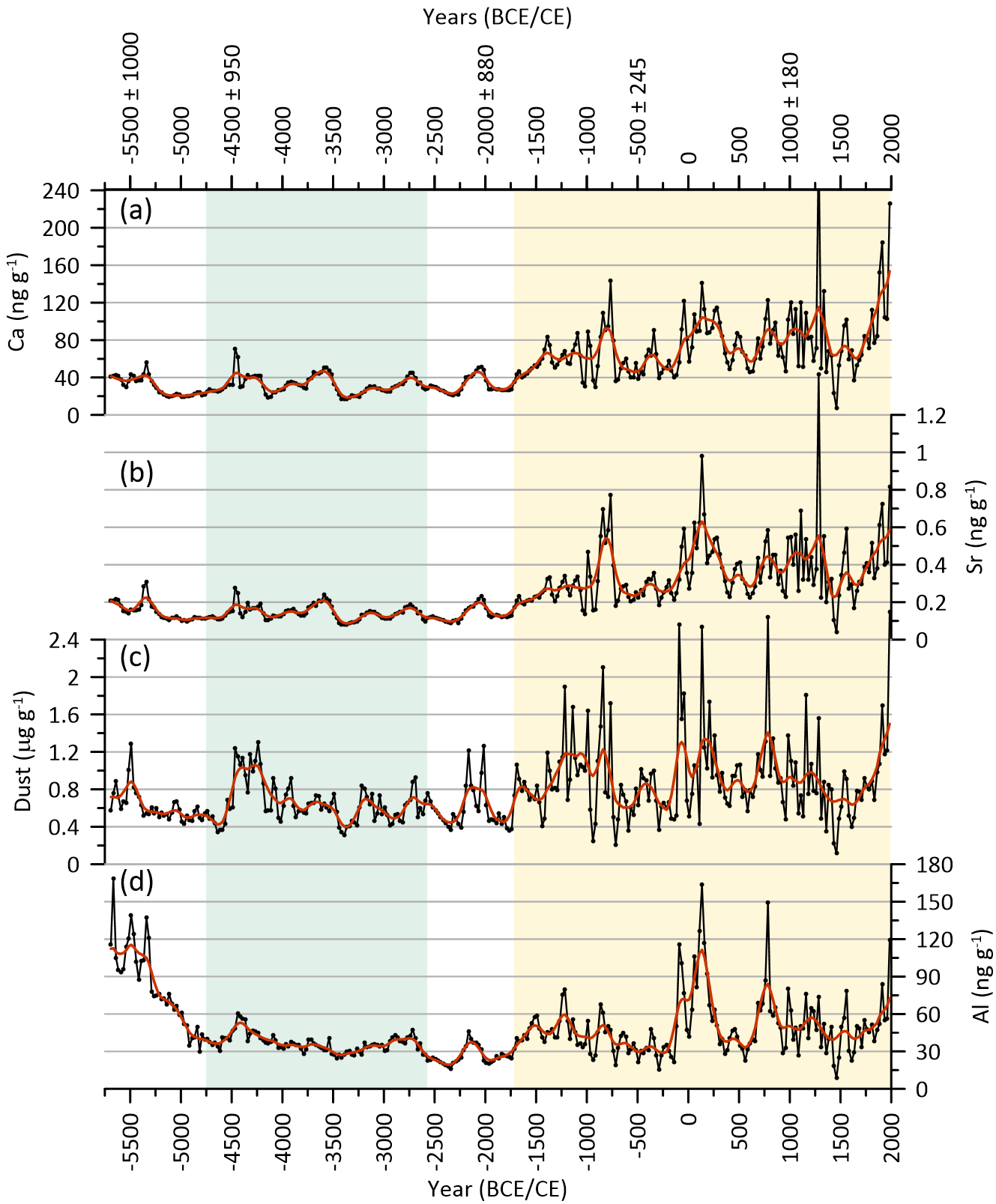
Figure 2 : Records of calcium (a), strontium (b), insoluble dust (c), and aluminum (d) in ice from the Dôme du Goûter deposited over the past 7,750 years. The yellow band indicates the period of aridification in the Sahara that brought an end to the “Green Sahara” (green band).
This research was supported by INSU-CNRS and ADEME (the LEFE-CHAT “ESCARGO” program) and the European programs ALPCLIM and CARBOSOL.
More infos:
Legrand, M., McConnell, J. R., Dulac, F., Dayan, U., Preunkert, S., Chellman, N., Desboeufs, K., Wensman, S., & Bergametti, G. (2026). An 8,000 years Alpine ice‐core record of climate and dust: The role of Saharan dust. Geophysical Research Letters, 53, e2026GL123787. https://doi.org/10.1029/2026GL123787